 Home Page
Many parents expect their child's feet to point straight ahead when they start walking. Some children walk with their feet turned inward instead. This is called intoeing.
Intoeing is common in children and is usually not a cause for concern. In most healthy children, it improves on its own as they grow, typically by age 10 to 12.
A small number of children continue to have intoeing as they get older. Most do not have any ongoing functional problems from it, such as tripping, pain, or difficulty with common daily activities. However, if a child is older than 10 and has frequent tripping, pain, limping, or swollen joints, they should be evaluated by a pediatric orthopedic provider.
What causes intoeing?
Intoeing is usually caused by one or more of these conditions:
Metatarsus adductus (curved foot)
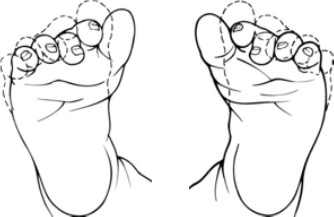
This condition causes the front part of the foot (as known as the forefoot) to curve inward. It is thought to be related to the baby's position before birth.
- Most children improve without treatment.
- Your provider may recommend gentle stretching exercises.
- Sometimes night-time bracing with Bebax shoes may be used to gently stretch the foot while the child sleeps.
- In rare cases, a cast may be recommended if the foot is stiff or painful.
Tibial torsion (twisted shinbone)
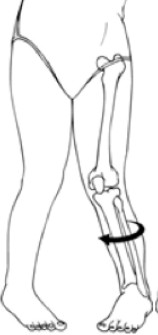
This happens when the tibia (shinbone) twists inward, causing the feet to point inward. It is the most common cause of intoeing in toddlers between 1 and 3 years old.
- It is also thought to be related to the baby's position before birth.
- Some children may appear bowlegged.
- The twisting usually improves as the child grows.
- Most children outgrow this condition before starting school.
- Braces, orthotics, and special shoes do not help correct the twisting of the shinbone.
- Surgery is rarely needed.
Femoral anteversion (twisted thighbone)
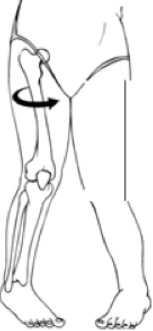
This condition happens when the femur (thighbone) turns inward. As a result, the knees and feet point inward.
Children with femoral anteversion often:
- Sit in a "W" position.
- Run with a swinging or "windmill" motion of the legs.
- Show the most noticeable intoeing between ages 2 and 5.
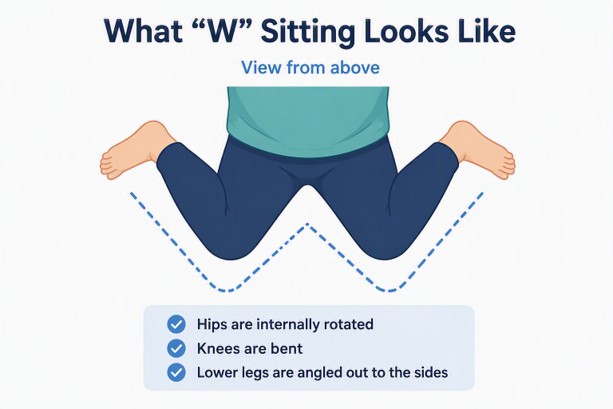
Other facts or information:
- It may be more common in girls.
- It can run in families.
- Children who are very flexible or hypermobile may show it more noticeably.
- It often improves gradually until about age 12.
- Orthotics, braces, special shoes, physical therapy, and exercises do not correct it.
- Surgery is rarely needed.
Will intoeing cause problems later?
Children with more noticeable intoeing may trip and fall more often, especially when they are young. However, intoeing usually does not:
- Cause pain
- Make it harder to learn to walk
- Lead to arthritis later in life
Most cases improve naturally as children grow. Research has not shown that orthotics, braces, special shoes, physical therapy, or exercises correct intoeing.
Surgery is only considered in rare, severe cases when intoeing continues to cause significant problems, such as ongoing pain or frequent tripping, especially in children older than 10 years. These children should be evaluated by a pediatric orthopedic provider.
This information is for educational purposes only. It is not intended to replace the advice of your health care providers. If you have any questions, talk with your doctor or others on your health care team.
If you are a Gillette patient with urgent questions or concerns, please contact the Nurse Help Line at 651-229-3890.
The information on this page is reviewed by Gillette Children's medical editors for general educational purposes.
