 Home Page
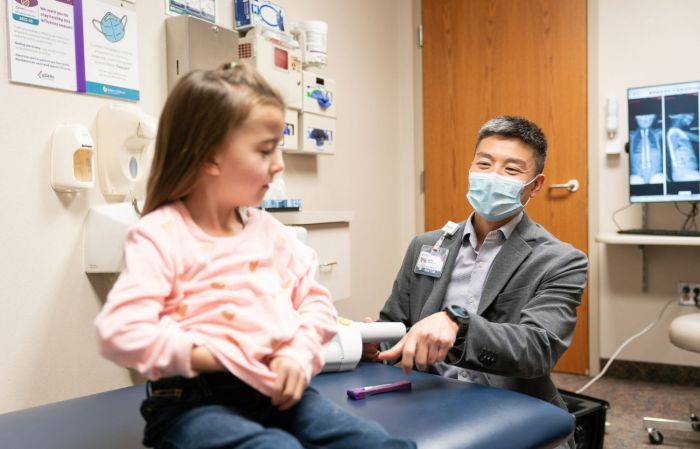
A study at Gillette Children's affirms that spine surgery is safe for pediatric patients with implanted devices.
Gillette Children’s Spine Institute researchers Sara Morgan, PhD, Clinical Scientist, and Walter Truong, MD, Pediatric Orthopedic and Spine Surgeon, have concluded a series of studies on the risks of surgical complications in patients with early-onset scoliosis (EOS) who also have an implanted electronic medical device. Overall, the conclusion is reassuring: Implanted programmable device-related complications following spine surgery are rare and often unrelated to surgical electromagnetic exposure or magnetically controlled lengthening performed in clinic.
For years, guidelines were limited surrounding one of pediatric orthopedics' most fragile patient groups: children whose curving spines need surgery, but who also carry an electronic device implanted to manage another condition like a shunt draining fluid from the brain, a pump delivering medication to the spinal canal, or a stimulator quieting seizures. The hesitation seems logical. The electrocautery, the magnets, and the monitoring currents of modern spine surgery all generate electrical or magnetic fields, and those fields might disrupt the device a child depends on.
A trio of studies from Gillette Children’s and the Pediatric Spine Study Group (PSSG), the most recent published in 2026, delivers a message that could reshape how community pediatricians and specialists think about referring these complex children for care: the device, by itself, is rarely the problem.
"The instinct to protect the implanted device is understandable,” says Dr. Truong. “We don’t want to compromise managing a child’s other condition, but the safety doubts were built on a handful of decades-old case reports, not on data. What this body of work does is replace anecdote with real guidelines and numbers, and both are reassuring."
Identifying the Gap
The story begins with a 2022 survey of pediatric spine surgeons, which made one thing clear: spine surgeons just didn’t know the ‘right’ thing to do. The team found striking variations in practice. Depending on which implant a child had, anywhere from roughly three in ten to six in ten surgeons said they altered their operative plan. Some survey respondents even declined to use a favored technology, magnetically controlled growing rods that can be lengthened over time without repeat surgery, in children with a brain-fluid shunt at all.
“To us, the survey made it clear that across the US, children with EOS weren’t getting care based on evidence, but rather which surgeon happened to be in the room. That’s what motivated us to take the survey further and develop the two research projects that came after: in 2024, collaborating on guidelines, and in 2026, figuring out what the risks actually were for kids with implanted devices,” says Truong.
"When you see wide variation in clinical decisions, it usually means clinicians don’t have the information they need," says Sara Morgan, PhD, lead spine researcher at Gillette Children’s. "Surgeons were each making a reasonable judgment. The problem is that reasonable judgments can still lead some kids away from procedures that are beneficial.”
Building a Consensus around EOS Devices and Spine Surgery
A 2024 consensus study assembled 25 specialists, including not only spine surgeons but neurologists, neurosurgeons, cardiologists, and otolaryngologists who manage the use of these devices. Researchers ran them through repeated, anonymous rounds of voting until they converged on shared recommendations.
The panel reached agreement on 39 specific statements, with concurrence ranging from 94% to 100%. Their conclusions were notably confident: growing rods can be safely placed and lengthened across the full range of devices, provided the rod and its external magnet are kept a sensible distance away. Most devices should be switched off or set to a resting mode before surgery and checked afterward. Even electrical cautery, a longtime subject of cautionary tales, was deemed usable with straightforward precautions.
The guidelines were a meaningful step. But consensus, however expert, is still opinion. The panel said as much, noting their guidance reflected a review of mostly bench studies, personal experience, and judgment rather than outcomes data drawn from real patients.
Crunching the Numbers
The final piece, what families actually expect, came in the 2026 multicenter study. Drawing on a registry of more than 10,000 EOS patients, researchers identified 100 children who had an implanted device and at least two years of follow-up after surgery. These were not easy cases: most had neuromuscular scoliosis, a curvature driven by an underlying nerve or muscle disorder, and most could not walk.
Complications of some kind were common (as they are in any medically fragile group), with 55% of the children experiencing at least one problem within two years, most often wound-related. But complications tied specifically to the implanted device were rare: just seven children.
All seven occurred in kids with shunts or baclofen pumps, and most issues surfaced more than 90 days after surgery, long after the choices made in the operating room. In the single growing-rod patient whose device malfunctioned, the malfunction appeared more than 100 days before the first magnetic lengthening — meaning the procedure could not have caused it.
“The details of these 7 cases with device-related complications were important," said Dr. Morgan. "If the electromagnetic fields during the surgeries or rod lengthenings were the problem, you'd expect the failures to cluster around these timepoints. Because the issues scatter across months, that points toward the ordinary risks these devices carry anyway."
The study had limits: a small sample, backward-looking design, and a device mix skewed toward shunts and pumps. Thus, a measured but confident conclusion: the mere presence of a device may not meaningfully raise surgical risk, while avoiding or delaying a beneficial operation may carry its own dangers.
Equipped for Complexity
This research emerged from the intersection of complex condition management and surgical spine expertise. Founded in 1897 as the first hospital in the United States dedicated to children with physical disabilities, Gillette Children's one of the nation's largest pediatric specialty care hospitals and oldest providers of pediatric spine care. Gillette and its Spine Institute, which earned Advanced Pediatric Spine Certification from DNV Healthcare, performs nearly 300 spine surgeries a year, logs more than 4,000 clinical visits, and has drawn patients from 15 states and 4 countries over the past five years.
That expertise sits precisely where cases are the hardest, caring for children with a spinal deformity layered on a neurologic or muscular disease. Beyond idiopathic scoliosis, Gillette treats neuromuscular scoliosis associated with cerebral palsy, spina bifida, muscular dystrophy, and spinal muscular atrophy — the same conditions that bring implanted shunts, pumps, and stimulators into the operating room. The hospital is home to one of the nation's highest concentrations of pediatric orthopedic surgeons, alongside pediatric neurosurgeons, physical medicine and rehabilitation doctors, and neurologists who manage these very devices.
That depth of expertise is also what makes the institution a research engine. Gillette's spine programs focus on long-term outcomes across the various types of scoliosis, and these three studies reflect the journey from documenting the problem, to building consensus, to measuring real outcomes.
"You need patient volumes and you need the right specialists in the same building to study a question like this," says Dr. Morgan. "A child with neuromuscular scoliosis and an implanted pump isn't unique here — they’re the core of the work."
Reassurance for Families Considering Spine Surgery
For parents weighing whether their child can safely undergo spine surgery, and for the pediatricians or surgeons advising them, the conclusion of these studies is that a shunt or a pump is something to be aware of and to take appropriate safety measures but not something that prevents the best possible treatments. At Gillette, that coordination of safety measures is built into the model: pediatric orthopedic surgeons, neurosurgeons, physical therapists, an onsite orthotics team, and other specialists collaborate on a single, personalized plan for each child — exactly the multidisciplinary structure the 2024 consensus guidelines call for.
"At Gillette, we’ve been confidently doing procedures on children with devices for years. Because that’s one of our main patient populations, our physician anecdotes and personal experience supported this conclusion from the beginning. We could see the benefits of these surgeries seemed to outweigh the risks,” says Dr. Truong. “For many providers across the country, though, the question used to be, 'Can this child even have a spine surgery?' the better question, and the one the evidence now supports, is, 'How do we plan this surgery well?'"
None of this turns spine surgery in a medically complex child into a routine affair. These remain demanding operations on vulnerable patients, and the studies' authors are the first to say so. But the arc of the research – from varied practice, to expert consensus, to real-world outcomes – bends toward a single, clinically useful idea: the implant a child carries to manage one condition need not stand in the way of treating another.
Join Our Partners in Care Community!
Subscribe to Partners in Care Journal, a newsletter for medical professionals.
Subscribe Today